
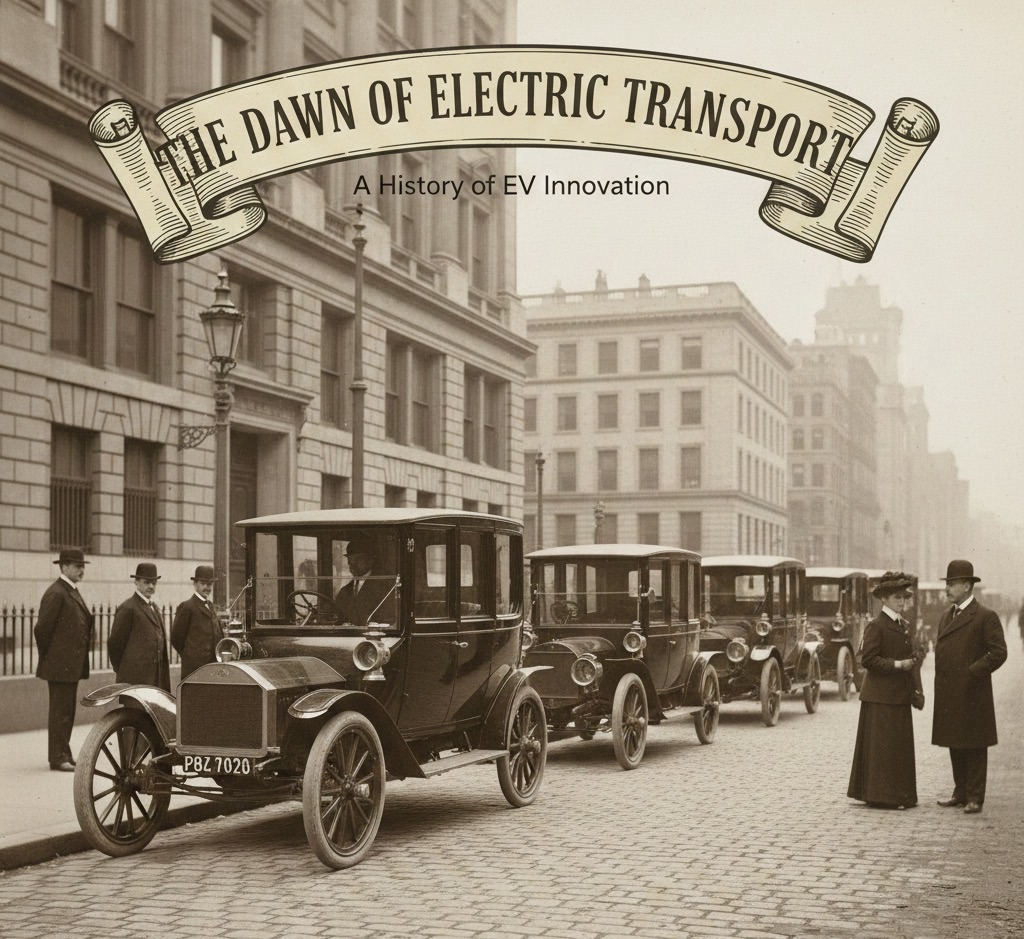
Electric Cars: The “New” Technology That Predates Petrol
Electric vehicles are often framed as a response to climate change or rising fuel prices. In reality, EVs are neither new nor reactive. They are one of the earliest solutions ever proposed for personal mobility.
What fascinates me most about EV history isn’t innovation — it’s timing. Electric cars were technologically valid long before the world was ready for them.
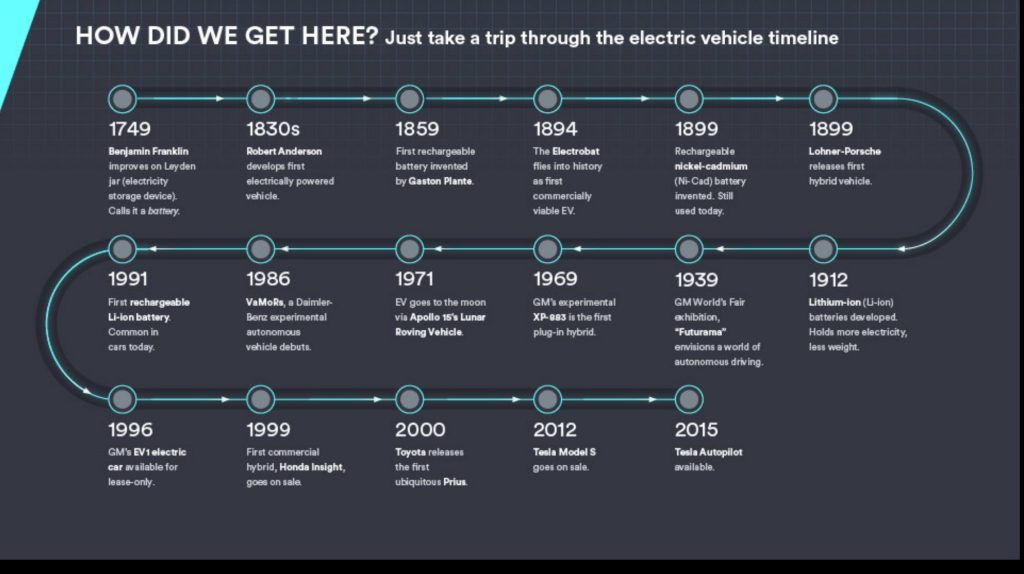
Electric Vehicle History Timeline — From Early Battery Experiments to Modern EVs
A visual journey tracing key global milestones in electric vehicle development, showing how breakthroughs in batteries, engineering, and technology over nearly three centuries shaped today’s electric mobility.
When Electric Cars Were the Sensible Choice (Late 1800s)
By the end of the 19th century, three propulsion technologies competed for dominance:
– Steam
– Petrol
– Electric
Electric cars quickly found favor in cities. They were quiet, mechanically simple, and didn’t require hand cranking or fuel handling. At a time when roads were short and urban-focused, range wasn’t a critical limitation.
The problem wasn’t that EVs were bad.
The problem was that cities — and expectations — grew faster than batteries could.
Why Internal Combustion Won (And EVs Didn’t)
A single invention didn’t cause the downfall of early electric vehicles — it was a system-level shift.
Three forces aligned against EVs:
1. Mass production, led by Henry Ford, drastically reduced petrol car costs.
2. Cheap oil made long-distance travel practical.
3. Battery chemistry stagnated for decades
From an engineering standpoint, this is crucial:
ICE vehicles evolved rapidly because energy storage was externalised (fuel), while EVs were limited by onboard storage.
By the 1920s, electric cars had effectively disappeared from consumer markets.
Decades in the Background: 1930s–1970s
For nearly 50 years, electric propulsion survived quietly in industrial applications:
Forklifts Rail systems Factory vehicles
This period mattered more than it seems. It kept electric motors, controllers, and power electronics alive — even as consumer cars transitioned to being fully petrol-centric.
When energy crises hit in the 1970s, engineers didn’t start from zero. They already knew electric drivetrains worked. Batteries were still the bottleneck.
The EV1 Era: Proof Without Timing
In the 1990s, General Motors launched the EV1 — a car that was genuinely ahead of its time.
From a technical perspective:
Aerodynamics were exceptional Acceleration was instant Maintenance requirements were minimal
Yet the supporting ecosystem — charging, policy, cost structure — simply didn’t exist. The EV1 failed not as a machine, but as a product in an unready market.
That lesson shaped the next wave of EV development.
Lithium-Ion Batteries: The Inflection Point
Everything changed when lithium-ion batteries entered the automotive space.
For the first time, engineers had:
Acceptable energy density Reasonable charge times Scalable manufacturing
This single advancement unlocked the modern EV era more than any regulation or incentive ever could.
Tesla’s Real Contribution Was Not the Battery
When Tesla launched the Roadster in 2008, the car itself wasn’t revolutionary in isolation.
What was revolutionary:
EVs were positioned as desirable, not compromised Software became central to vehicle behaviour Charging infrastructure was treated as part of the product
Tesla reframed electric cars from alternatives to aspirations — and the industry followed.
EVs Today: Engineering Simplicity, System Complexity
Modern electric vehicles are mechanically simpler than ICE cars:
Fewer moving parts No multi-gear transmissions Lower service requirements
But the complexity hasn’t disappeared — it has shifted into:
Battery management systems, thermal control, Power electronics, Software integration
From an engineering lens, EVs represent a trade-off:
Less mechanical complexity, more electrical and software intelligence.
Where Electric Vehicles Are Headed
The future of EVs will be shaped less by motors and more by:
Battery chemistry (solid-state, LFP evolution), Charging speed, and grid integration, Software-defined vehicle platforms
The core electric drivetrain is already a mature technology. What’s changing now is how intelligently energy is stored, managed, and delivered.
Final Thought: EVs Didn’t Win — They Waited
Electric vehicles didn’t lose to petrol cars because they were inferior.
They lost because the world wasn’t ready to support them.
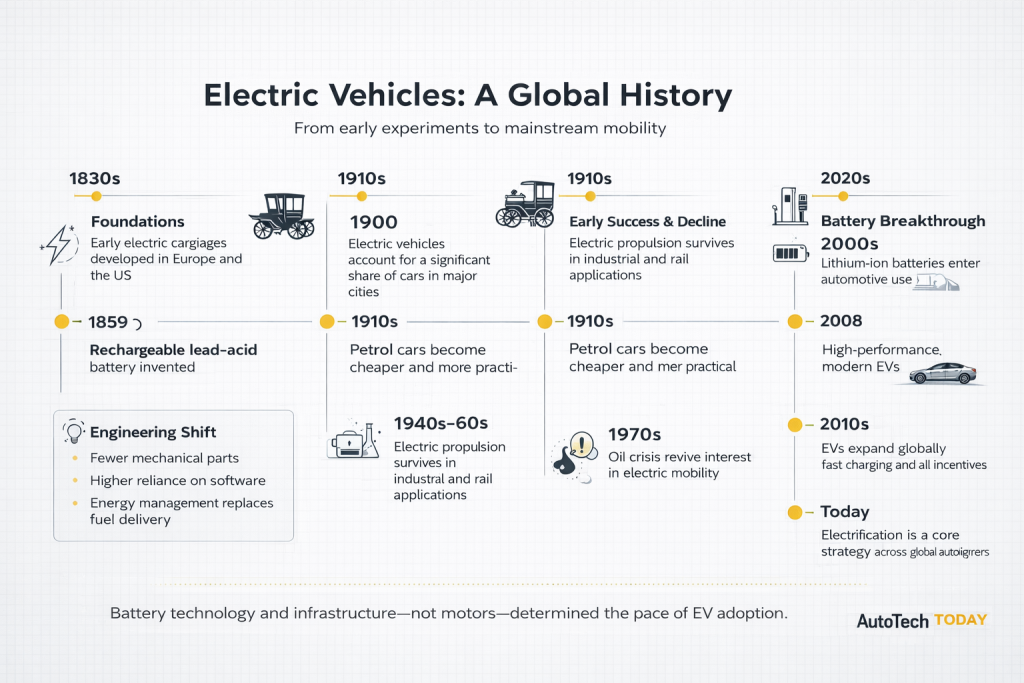
How Electric Vehicles Reached the Mainstream
An at-a-glance timeline, showing how electric vehicles evolved from early experiments into today’s global mobility solution—driven less by motors and more by progress in batteries, infrastructure, and systems engineering.
Today, infrastructure, software, and energy systems are finally catching up to an idea that’s been around for over a century.
This isn’t a revolution.
It’s a long-overdue return.