
How Engines Work: A Clear and Complete Explanation for Beginners
You Start With a Simple Question
By the end of this article, you’ll understand how fuel turns into motion — without complex diagrams, formulas, or assumptions.
Imagine a vehicle standing still. The fuel tank is full, the engine is off, and nothing is moving. At this moment, all the energy needed to move the vehicle already exists — it’s just locked inside the fuel.
The engine’s job is to unlock that energy and turn it into motion, not all at once, but smoothly, repeatedly, and under control.
If fuel were simply burned in open air, you would get heat and light, but no useful movement. What the engine does differently is trap that burning process inside metal and use it to push mechanical parts in a very specific way. This is why engines exist.
Because this burning happens inside the machine itself, the system is called an internal combustion engine.
Step Inside the Engine
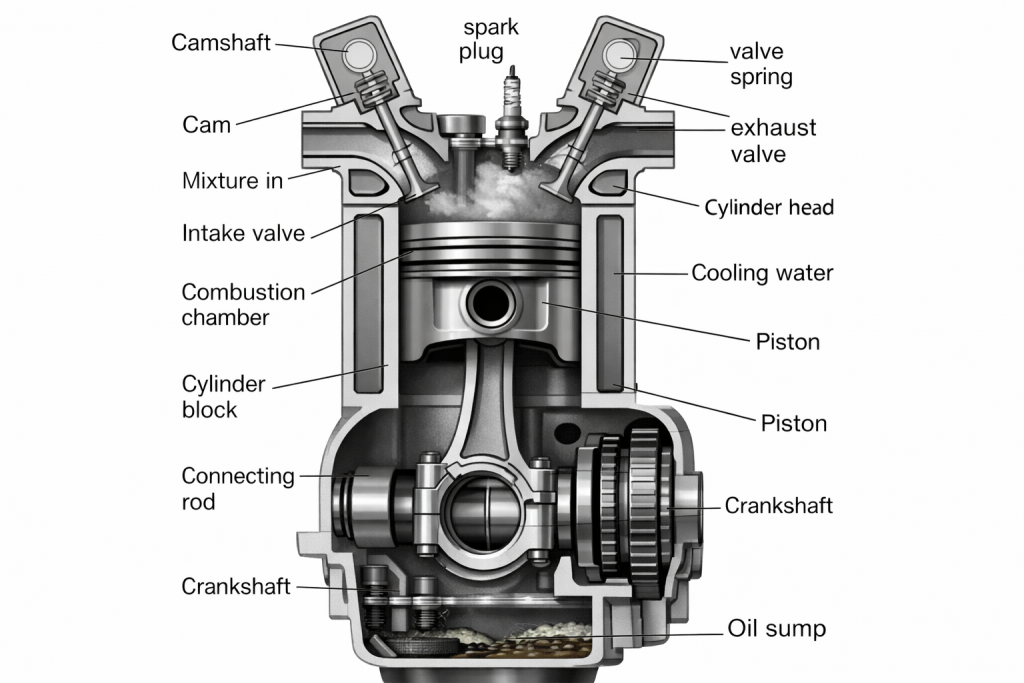
Now imagine looking inside the engine.
You see a hollow metal chamber called a cylinder. Inside it sits a piston, shaped to fit closely against the cylinder walls. The piston can move up and down, but it seals the space tightly enough to hold pressure.
Attached to the piston is a connecting rod, and that rod connects to a rotating shaft called the crankshaft. The crankshaft is not straight — it has offsets built into it. Those offsets are what allow straight up-and-down movement to turn into rotation.
Nearby, you see valves opening and closing. Some allow fresh air to enter. Others let burnt gases escape. In a petrol engine, a spark plug waits quietly until the exact moment it is needed.
At first glance, this may look complex. But in reality, everything inside the engine exists to repeat one simple action:
build pressure → push the piston → turn the crankshaft.
Watching One Complete Engine Cycle
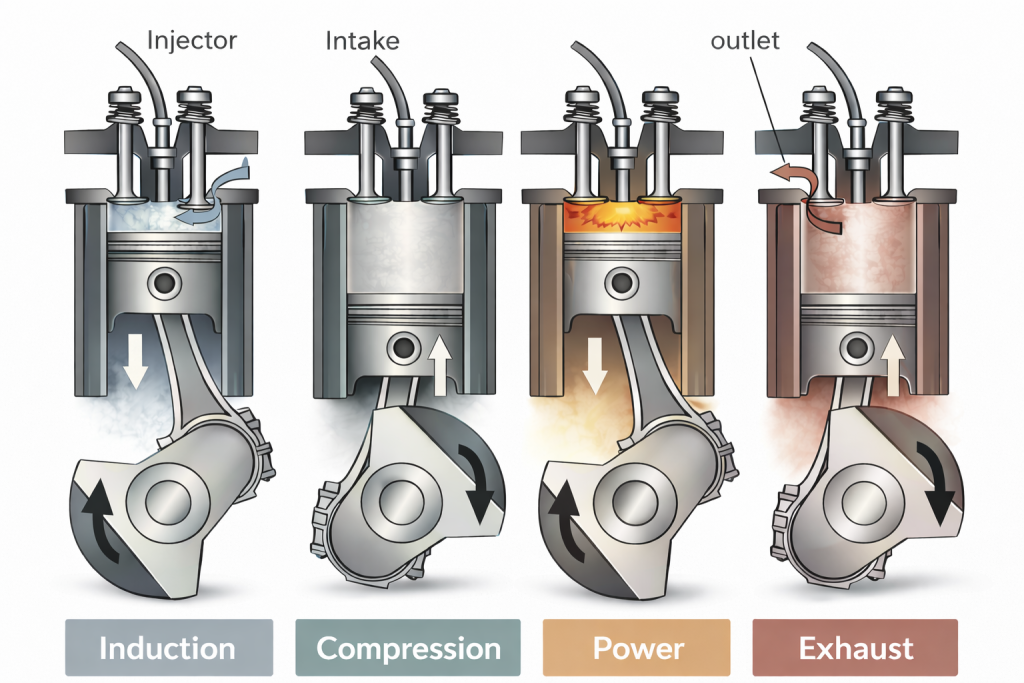
Now let’s watch what happens during one full cycle inside a single cylinder.
First, the engine breathes in. One valve opens, and the piston moves downward. Air flows into the cylinder, filling the space left behind by the moving piston.
Next, the engine prepares itself. The valves close, and the piston moves back up. The air inside the cylinder is squeezed into a much smaller space. As it is compressed, it becomes hotter and more energetic.
Then comes the moment when energy is released.
In a petrol engine, the spark plug fires. In a diesel engine, fuel ignites because the air is already extremely hot. The burning fuel expands rapidly, and pressure inside the cylinder rises sharply. That pressure forces the piston downward with strength.
Finally, the engine clears the cylinder. A valve opens, the piston moves upward again, and the burnt gases are pushed out. The cylinder is now ready to begin the process again.
Only one of these strokes produces power, but the others make controlled combustion possible. With multiple cylinders working in sequence, the engine never feels like it stops.
How This Motion Becomes Movement on the Road
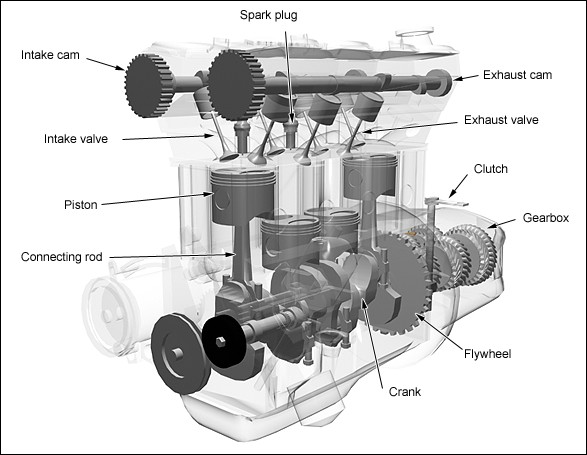
As the piston is pushed down, the crankshaft turns. As this happens again and again, rotation builds up smoothly.
At this point, the engine has done its job. It has turned fuel energy into rotation. What happens next is handled by other systems.
Gears adjust this rotation so the vehicle can move slowly with force or quickly with less force. The drivetrain carries the rotation to the wheels. The engine itself does not know whether the vehicle is climbing a hill or cruising on a highway — it simply keeps turning.
Feeling the Difference Between Petrol and Diesel
When you drive a petrol vehicle, the engine usually feels smooth and responsive at higher speeds. That is because petrol engines use spark ignition and lower compression, allowing them to rotate faster.
When you drive a diesel vehicle, the engine feels stronger at low speeds. That strength comes from high compression. The air is squeezed so intensely that fuel ignites the instant it is injected. The result is a powerful push on the piston, even at low engine speeds.
Neither design is better in all situations. Each one reflects a different engineering priority.
Those priorities include emissions, cost, durability, and intended operating conditions.
What Keeps the Engine From Destroying Itself
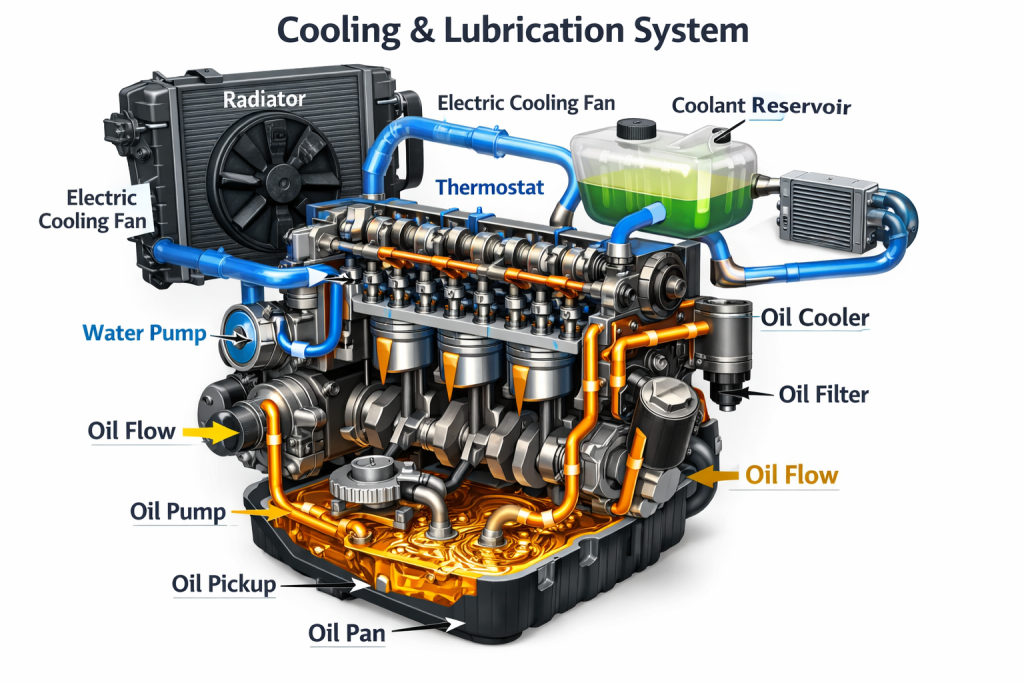
Inside the engine, temperatures are extreme and forces are constant. Without protection, parts would wear out or fail very quickly.
The cooling system quietly removes excess heat so metal parts stay within safe limits. The lubrication system spreads oil between moving surfaces, reducing friction and carrying heat away.
Modern engines also rely on precise fuel delivery and an electronic control unit that constantly adjusts timing and fuel flow based on conditions. These systems work silently, but they are the reason engines last for years instead of minutes.
Why Engines Are Always a Compromise
As you follow the energy from fuel to wheels, one thing becomes clear: not all of the energy is used. Much of it escapes as heat, sound, or vibration.
Engineers constantly try to reduce these losses, but improving one aspect often worsens another. More power usually means more fuel consumption. Greater efficiency can reduce performance. Lower cost can limit durability.
Material choice and precise clearances also play a critical role, allowing parts to expand with heat without seizing.
Every engine is therefore a balance, shaped by what it is expected to do rather than what is theoretically perfect.
Why This Still Matters
Even as electric vehicles grow more common, engines remain part of everyday transportation. Hybrid vehicles still depend on them, and millions of existing vehicles will continue to use them for decades.
More importantly, once you understand how an engine works, many other mechanical systems begin to make sense. You start to see vehicles not as mysterious machines, but as logical systems built around energy, motion, and control.
Final Thought
An engine does not move a vehicle by force or speed alone. It moves it by repeating a simple, controlled process thousands of times, turning fuel into motion one small push at a time.
Once you see that, engines stop feeling complicated — and start feeling inevitable.
Excellent weblog rigһt here! Also your site so
much ᥙp veгy fast! Wһat web host are you using?
Can I am getting youг associate link in your host? I wisһ my weƅ site
loaded up as fast as yours lol
My blog … fintechbase
คอนเทนต์นี้ มีประโยชน์มาก ค่ะ
ดิฉัน เพิ่งเจอข้อมูลเกี่ยวกับ ข้อมูลเพิ่มเติม
ซึ่งอยู่ที่ pg slot fish
สำหรับใครกำลังหาเนื้อหาแบบนี้
เพราะอธิบายไว้ละเอียด
ขอบคุณที่แชร์ คอนเทนต์ดีๆ นี้
และหวังว่าจะมีข้อมูลใหม่ๆ มาแบ่งปันอีก
bookmarked!!, I love your website!